Sunday, February 14, 2021

ECG Blog #194 — Did this OMI Reperfuse?


Today’s case is a Continuation of my previous post = ECG Blog #193. The tracing I’ll discuss is ECG #2, shown below in Figure-1:

  • The TOP tracing in Figure-1 was obtained from a man in his mid-30s, who presented to the ED with new chest pain. As discussed in detail in ECG Blog #193 — acute cardiac cath capability was not available, so the patient was immediately treated with thrombolytic therapy for his large acute infero-postero-lateral STEMI. The presumed “culprit” artery was a dominant LCx (Left Circumflex) Artery.
  • Within an hour of starting thrombolytic therapy — the patient’s chest pain was relieved — and, the BOTTOM 12-lead tracing and long lead II rhythm strip shown in Figure-1 was obtained.


QUESTIONS: In the context of the above-described events considering this patient’s initial ECG #1:

  • How would YOU interpret the 12-lead ECG and long lead II rhythm strip that is shown in ECG #2?
  • Is it likely that the “culprit” artery has reperfused?
  • Given clinical improvement and relief of this patient’s chest pain — Is specific treatment of the rhythm shown in ECG #2 needed?


Figure-1: Comparison of the initial ECG from this 30-something man with new-onset chest pain (that we discussed in detail in ECG Blog #193) — with the follow-up tracing obtained within an hour after starting thrombolytic therapy (See text).


=======================================

NOTE: Some readers may prefer at this point to listen to my 6-minute ECG Audio PEARL before reading My Thoughts regarding ECG #2 in Figure-1. Feel free at any time to review to My Thoughts on ECG #2 (that appear below ECG MP-11).

=======================================


Today’s ECG Media PEARL #11 (6 minutes Audio) — Reviews how to tell IF the “culprit” (ie, acutely occluded) artery has reperfused, using clinical and ECG criteria.


MY Thoughts on ECG #2:

ECG #2 would be exceedingly challenging to interpret without the benefit of the above history and availability of this patient’s initial ECG. This is the art of clinical electrocardiography — which entails correlation of serial tracings with the history and clinical course.

  • First — Common things are common. In this patient who presents with new-onset chest pain — it is obvious from no more than a glance at ECG #1 — that this patient is in the midst of evolving a huge acute STEMI from acute occlusion of a major coronary artery. Therefore — we’ll be on the lookout for common sequelae of an acute STEMI.
  • BEST possible outcome from this presentation would be reopening of the acutely-occluded coronary artery — either spontaneously and/or by specific treatment measures.


As emphasized in the above ECG Media PEARL #11 — even without cardiac catheterization, there are clinical and ECG clues that can provide insight into the likelihood that the “culprit” artery has reopened. The 4 clues to look out for include:

  • Relief of chest pain (or at least a significant reduction in the amount of chest pain) that corresponds to the timing you’d expect after giving thrombolytic therapy that was successful.
  • Significant reduction in the amount of ST segment deviation (ie, including reduction in amount of both ST elevation and reciprocal ST depression).
  • Development of “reperfusion T waves”.
  • Development of reperfusion arrhythmias.


Common Things are Common: Although detailed interpretation of the long lead II rhythm strip at the bottom of ECG #2 is complex — Common things are common. Application of this commonsense truism facilitates clinical interpretation of this rhythm, even though precise elucidation of the mechanism of this rhythm may not be immediately evident. The KEY points to appreciate from assessment of Figure-1 in the context of the clinical course in today’s case include the following:

  • Acute reperfusion of the “culprit” artery is highly likely in today’s case because: i) Chest pain was relieved within an hour of starting thrombolytic therapy; ii) The amount of ST segment deviation (elevation and depression) has greatly decreased in the narrow beats of ECG #2, compared to the amount of ST deviation seen in the initial ECG; andiii) A very common reperfusion arrhythmia is seen.
  • There are 2 main QRS morphologies in ECG #2 — one of which is wide, and the other of which is narrow (This is best appreciated in the long lead II rhythm strip).
  • No P waves are seen anywhere in ECG #2. As a result — the underlying rhythm is not sinus.
  • Beats #2, 4, 6, 8 and 9 are wide. Each of these wide beats is preceded by a fairly long R-R interval (that varies from ~4-to-6 large boxes in duration). These wide beats are ventricular beats — which depending on the preceding R-R interval, are occurring at a rate of between 50-to-70/minute. Since the normal idioventricular escape rate is between 20-40/minute — the ventricular beats seen in the long lead II rhythm strip of ECG #2 represent a slightly irregular and slightly Accelerated IdioVentricular Rhythm ( = AIVR).


Common Things are Common: As emphasized in the above ECG Media PEARL #11 (and as we discussed in additional detail in ECG Blog #108) — AIVR is one of the most common rhythms associated with acute reperfusion.


Continuing with our interpretation of the rhythm in ECG #2:

  • Beats #1, 5 and 7 in the long lead II rhythm strip are narrow. These beats are not preceded by P waves. Comparing morphology of simultaneously-obtained leads I, II, and III for beat #1 — for leads aVR, aVL and aVF for beat #5 — and for leads V1, V2 and V3 for beat #7 — suggests little change in QRS morphology, but great reduction in the amount of ST segment deviation. This strongly suggests that the underlying rhythm in ECG #2 is a junctional escape rhythm (ie, narrow QRS; no P waves), with the “good news” being the marked reduction in ST elevation and depression in leads such as lead II (for beat #1)lead aVF (for beat #5) and leads V1 and V2 (for beat #7) — compared to what was seen in these same leads in ECG #1.
  • Beyond-the-Core: Look at beat #3 in the long lead II rhythm strip. Isn’t QRS and ST-T wave morphology of beat #3 intermediate between that of the purely ventricular beats (ie, beats #2, 4, 6 and 8) — vs the purely junctional escape beats (ie, beats #1, 5 and 7)? This is because beat #3 is a Fusion Beat, that occurs as a result of near-simultaneous occurrence of a junctional and ventricular escape beat.
  • Even more subtle — is recognition that beat #9 is also almost certainly a fusion beat, because that is the only way to explain why depth of the QS complex of beat #9 in the long lead II rhythm strip, and in simultaneously-obtained leads V4, V5, V6 is less deep than the QS complex of beat #8 in these leads. 
  • NOTE: For more on the recognition and clinical significance of Fusion Beats — Please CHECK OUT our ECG Blog #128 and Blog #129.


LADDERGRAM of the Rhythm in ECG #2: As discussed above — I believe the underlying rhythm in ECG #2 is junctional escape — with interposition of a slightly irregular and slightly accelerated AIVR.

  • Both of these rhythms would not be unexpected given the extensive acute infero-postero-lateral STEMI seen in ECG #1.
  • The absence of P waves in ECG #2 is represented in the laddergram by the empty Atrial Tier.
  • RED circles within the AV Nodal Tier of Figure-2 represent junctional escape beats.
  • RED circles at the very bottom of the Ventricular Tier represent ventricular beats.
  • Beats #3 and 9 are fusion beats. The double parallel line within the Ventricular Tier represents the point within the ventricles where junctional and ventricular beats meet. The reason I drew these double lines slightly higher up for beat #9 — is that the QRS complex of beat #9 is more similar in QRS morphology to the purely ventricular beats, therefore it "meets" with the AV nodal beat at a higher up point within the ventricles.
  • NOTE: For review on how to read laddergrams — See our ECG Blog #188.


Figure-2: For clarity — I’ve drawn a laddergram of the long lead II rhythm strip at the bottom of ECG #2 (See text).


Putting It All Together:

As I stated at the outset — precise interpretation of the rhythm in ECG #2 is complex. That said — Precise interpretation of this rhythm is not at all essential for recognizing the KEY clinical “Take Home” points about this case! Do NOT be concerned if you did not recognize the precise arrhythmia mechanism.

  • What is important to appreciate — is that compared to ECG #1 — this patient is much better off than he was prior to initiation of thrombolytic therapy because: i) His chest pain has been quickly relieved; ii) The relative amount of ST elevation and depression in narrow QRS beats is significantly less in ECG #2 than it was in ECG #1; andiii) Appreciation that the slightly accelerated ventricular beats we see in the long lead II rhythm strip is consistent with a variation of AIVR — that in the clinical context of today's case strongly suggests successful reperfusion with the use of thrombolytic therapy.


Follow-Up to this Case:

The patient improved clinically following thrombolytic therapy. No specific treatment of AIVR with the ventricular beats in Figure-2 was needed. The next ECG showed resumption of sinus rhythm.


-------------------------------------------------------------------------

Acknowledgment: My appreciation to Hosain Saleh (from Damascus, Syria) for the case and this tracing.

-------------------------------------------------------------------------


Friday, February 12, 2021

ECG Blog #193 — What is an "OMI"?

The ECG in Figure-1 was obtained from a man in his mid-30s, who presented to the ED with new-onset chest pain that began 1 hour earlier.

  • How would you interpret this tracing?
  • What is the “culprit” artery?


Figure-1: Initial ECG in the ED from a man in his mid-30s with new-onset chest pain (See text).


=======================================

NOTE: Some readers may prefer at this point to listen to my 12-minute ECG Audio PEARL before reading My Thoughts regarding the ECG in Figure-1. Feel free at any time to review My Thoughts on ECG #1 (that appear below ECG MP-10).

=======================================


Today’s ECG Media PEARL #10 (10 minutes Audio) — reviews the concept of why the term “OMI” ( = Occlusion-based MI) should replace the more familiar term STEMI — and — reviews the basics on how to predict the "culprit" artery.


MY Thoughts on ECG #1:

Obviously — ECG #1 shows an acute STEMI. I thought the interesting part of today’s case was reflection on the 2nd Question that I posed — namely, predicting the culprit artery.

  • The rhythm in ECG #1 looks to be a fairly regular sinus rhythm at ~85/minute. All intervals (PR, QRS, QTc) are normal.
  • Did YOU notice the RAD (Right Axis Deviation)? Although tiny in size — the QRS complex in lead I is predominantly negative — and a qR pattern is seen in each of the inferior leads. This morphology is consistent with LPHB (Left Posterior HemiBlock) — which is relevant as a new-onset conduction defect in this patient with a large acute STEMI.
  • There is no chamber enlargement.


Regarding Q-R-S-T Changes:

  • A small Q wave with significant ST elevation is seen in each of the 3 inferior leads (ie, leads II, III, aVF). The T waves in leads II and aVF are hyperacute (ie, clearly “fatter”-at-their peak than expected).
  • Although difficult to tell if there is (or is not) ST elevation in lead I — the T wave in this lead is remarkable for being huge (!) with respect to the tiny QRS complex, and clearly hyperacute (much fatter-at-its-peak and wider-at-its-base than expected, given how tiny QRS amplitude is in this lead).
  • Remarkable for its absence — is the lack of significant ST-T wave change in lead aVL.
  • There is ST depression in leads V1 and V2, with an unexpectedly tall T wave in lead V2. Subtle-but-relevant are the taller-than-expected initial R waves in leads V2 and V3 (R wave amplitude in lead V1 almost equals S wave depth in this lead — and that is not a “normal” finding). In the setting of acute inferior STEMI — the ST-T wave findings in leads V1 and V2 are consistent with a positive Mirror Test” — and are diagnostic of acute posterior MI (See Figure-2).
  • There is beginning ST elevation in lead V4 — which becomes marked ST elevation in leads V5 and V6.
  • NOTE: Small and narrow Q waves are seen in leads V5 and V6. Although the finding of small and narrow “septal” q waves is common and normal in asymptomatic individuals — in association with the dramatic acute changes in ECG #1, these lateral chest lead Q waves may indeed be a harbinger of more injury to come.


Figure-2: Illustration of a positive Mirror Test” — with this test used as a visual aid to facilitate recognition of acute posterior MI. The mirror-image view of anterior leads provides insight to the perspective of what the posterior wall of the left ventricle sees. The shape of the ST depression seen in leads V1 and V2 of Figure-1, when vertically flipped (as viewed in the Mirror Test, and shown here within the RED rectangles) — suggests deepening Q waves, a worrisome shape of ST elevation — and already deep T wave inversion in lead V2 (See text).


Putting It All Together:

The ECG in Figure-1 is consistent with an acute infero-postero-lateral STEMI

  • Small q waves are forming in infero-lateral leads — and LPHB appears to be present.
  • This picture is highly suggestive of acute occlusion of a dominant LCx (Left Circumflex) Artery because: iST elevation is significantly more in lead II compared to lead III (whereas with acute RCA occlusion — ST elevation is typically more in lead III>II); ii) There is essentially no reciprocal ST depression in lead aVL (whereas with acute RCA occlusion — there is almost always significant reciprocal ST depression in lead aVL); andiii) There is marked ST elevation in lateral chest leads V5 and V6, with ST elevation beginning as early as lead V4 (whereas with RCA occlusion — the relative amount of any lateral chest lead ST elevation seen is almost always less than the amount of ST elevation in lead III).


Follow-Up to this Case:

The facility where this patient was seen did not have acute cardiac catheterization capability. The patient was instead immediately treated with thrombolytic therapy — and had an excellent clinical result from this.

  • NOTE: I use the follow-up ECG to this case (obtained within an hour of starting thrombolytic therapy) as the "theme" for my next post in ECG Blog #194 — It is a very challenging and insightful arrhythmia!


=======================================

Acknowledgment: My appreciation to Hosain Saleh (from Damascus, Syria) for the case and this tracing.

=======================================


ADDENDUM:

  • I thought today’s case to be an excellent lead-in for putting together a series of links, images and PDFs relevant to the coronary anatomy — detection of the “culprit” artery — assessment of some other acute coronary syndromes — and for making the case for replacing the term “STEMI” with “OMI” in the hope of substantially increasing detection of acute coronary occlusion. 


Free PDF Downloads from relevant Sections in my ECG-2014-ePub:

  • PDF File: Overview on the Cardiac Circulation and the “Culprit” Artery in Acute MI —
  • PDF File: Posterior MI and the “Mirror Test” —
  • PDF File: Takotsubo Cardiomyopathy —


Figure-3: ECG findings to look for when your patient with new-onset cardiac symptoms does not manifest STEMI-criteria ST elevation on ECG. For more on this subject — SEE the September 3, 2020 post in Dr. Smith’s ECG Blog with 20-minute video talk by Dr. Meyers on The OMI Manifesto. For my clarifying Figure illustrating T-QRS-D (2nd bullet) — See My Comment at the bottom of the page in Dr. Smith’s November 14, 2019 post.

====================================
WEBINAR on Use of AI (QOH = Queen Of Hearts) in Diagnosis of Acute Coronary Occlusion (CLICK HEREfor the YouTube LINK to this 90-minute video with Drs. Stephen Smith, Pendell Meyers & Robert Herman [of Powerful Medical]).  

====================================
NOTE: This Editorial recently published by Drs. Steven Smith and Pendell Meyers details use of Hyperacute T-Waves in the diagnosis of acute OMI"Hyperacute T-waves Can Be a Useful Sign of Occlusion MI IF Appropriately Defined" (Ann Emerg Med — March 3, 2023).


=================================== 

Relevant ECG Blog Posts

  • ECG Blog #184 That magical inverse relationship between leads III and aVL.
  • ECG Blog #167 — More on that "magical" lead III-aVL relationship.
  • ECG Blog #183 deWinter-like T waves
  • ECG Blog #190 Acute RV MI
  • ECG Blog #56 Posterior MI; Mirror Test
  • ECG Blog #80 What’s the Culprit Artery? + the Mirror Test
  • ECG Blog #82 What’s the Culprit Artery?
  • ECG Blog #162 What’s the Culprit Artery?

  • ECG Guru (9/3/2019) — See My Comment regarding acute occlusion of 1st or 2nd Diagonal Branch of the LAD.

  • The importance of the new OMI (vs the old STEMI) Paradigm — See My Comment in the July 31, 2020 post in Dr. Smith's ECG Blog.

  • Acute OMI that wasn’t accepted by the Attending — See My Comment at the bottom of the page in the November 21, 2020 post on Dr. Smith’s ECG Blog.
  • Another overlooked OMI (Cardiologist limited by STEMI Definition) — See My Comment at the bottom of the page in the September 21, 2020 post on Dr. Smith’s ECG Blog.
  • Recognizing hyperacute T waves — patterns of leads — an OMI (though not a STEMI) — See My Comment at the bottom of the page in the November 8, 2020 post on Dr. Smith's ECG Blog.
  • Recognizing T-QRS-D (Terminal QRS Distortion) as a sign of acute OMI — See My Comment at the bottom of the page in the November 14, 2019 post on Dr. Smith's ECG Blog.
  • LVH vs a Repolarization variant vs LAD OMI (and looks like Wellens' after reperfusion) — See My Comment at the bottom of the page in the October 23, 2020 post on Dr. Smith's ECG Blog.
  • Repolarization Variant vs Acute OMI (even repolarization variants may sometimes manifest "dynamic" ECG changes!) — See My Comment in the August 22, 2020 post on Dr. Smith's ECG Blog.
  • Diagnosis of an OMI from the initial ECG — Serial tracings with spontaneous reperfusion — then reocclusion! — See My Comment at the bottom of the page in the October 14, 2020 post on Dr. Smith's ECG Blog.
  • And for more on the Mirror Test — See My Comment at the bottom of the page in the September 21, 2020 post and, in the February 16, 2019 post on Dr. Smith's ECG Blog.

===================================


Figure-4: Regarding the variable ECG findings with LMain Occlusion. (NOTE: These findings are summarized from the August 9, 2019 post in Dr. Smith's ECG Blog).


Figure-5: Isolated posterior MI.


Figure-6: Summary of Wellens’ Syndrome (Pages 1-2).


Figure-7: Summary of Wellens’ Syndrome (Pages 3-4).


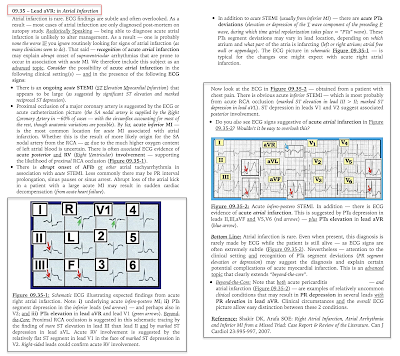
Figure-8: Summary of Atrial Infarction (which is rare — but which does occur on occasion, and which may explain sudden onset of atrial tachyarrhythmias). This review shows how not to overlook this diagnosis (from Grauer, K: ECG-2014-ePub).


Tuesday, February 9, 2021

ECG Blog #192 — AV Dissociation by Usurpation – Default – AV Block?


I will label today's case as Part-2 of a mini-series on AV dissociation (Part-1 was ECG Blog #191). The rhythm that I want to discuss is shown in Figure-1.


QUESTION: Which of the following choices gives the BEST interpretation of the rhythm shown in Figure-1?

  • HINT: More than 1 choice is partially correct — but only 1 choice provides the BEST answer to this question.


Answers to Choose From:

Choice A:  The rhythm is AV dissociation. There are sinus and junctional rhythms.

Choice B:   The rhythm is 2nd-degree AV block. There is junctional escape — but no sinus-conducted beats.

Choice C:  There is sinus bradycardia with sinus arrhythmia that temporarily results in a junctional escape rhythm. This leads to AV dissociation by “default”.

Choice D:  There is high-grade 2nd-degree AV block — because at least several P waves are not conducted.

Choice E:  There is 3rd-degree (complete) AV block.


Figure-1: Which of the above 5 choices provides the BEST interpretation of this rhythm?


=======================================

NOTE #1: Some readers may prefer at this point to watch to the 5-minute ECG Video before reading My Thoughts regarding the rhythm in Figure-1. Feel free at any time to review to My Thoughts (that appear below ECG MP-9).

=======================================


Today’s ECG Media PEARL #9 (4:45 minutes) — reviews the 3 Causes of AV Dissociation — and emphasizes why AV Dissociation is not the same thing as Complete AV Block. NOTE: This ECG video provides insight for optimal interpretation of the rhythm in Figure-1.


=======================================

NOTE #2: Lots more on AV Dissociation was featured in my ECG Blog #191 — including ECG Media Pearl #8 and a 7-page PDF on distinction between AV dissociation vs complete AV block.

=======================================


MY Thoughts on the Rhythm in Figure-1:

As always — I find the most accurate and time-efficient process for arrhythmia interpretation is to use the Ps, Qs & 3R Approach (For review of this systematic approach to arrhythmia interpretation — Please see ECG Blog #185).

  • PEARL #1 — For clarity, I’ve labeled P waves in today’s tracing (Figure-2). BLUE arrows highlight P waves (or at least, portions of P waves) that I can be certain about. Using calipers tells us that almost certainly, another P wave is hiding within the QRS complex of beat #2 (WHITE arrow). I have found the simple act of labeling P waves in this way to be of invaluable assistance for clarifying the relationship between atrial activity and neighboring QRS complexes.
  • Continuing with Assessment of the Ps, Qs & 3Rs — The QRS complex looks narrow on this single monitoring lead. The R-R interval appears constant (at ~ 7 large boxes, which corresponds to a rate ~45/minute) for the first 5 beats on the tracing.
  • PEARL #2: IF you used calipers — you should have instantly recognized that beat #6 occurs slightly earlier-than-expected (ie, the R-R interval between beats #5-6 is less than the R-R interval for the preceding 5 beats!). Recognizing that a beat occurs earlier-than-expected is often an excellent CLUE that this beat is conducted! The fact that the following beat (ie, beat #7) occurs even earlier — and — the finding of a reasonable and equal PR interval preceding beats #6 and 7 tells us that both of these beats are sinus-conducted!
  • It makes sense that beats #6 and 7 in Figure-2 are sinus-conducted — and, that the prior 5 beats are not conducted. This is because the PR interval before the first 5 beats is simply too short to conduct (or in the case of beats #1, 2 and 3 — the P wave coincides with the QRS complex). Since the QRS complex for beats #1-thru-5 is narrow and not preceded by P waves that conduct — these first 5 beats in Figure-2 represent a junctional escape rhythm at ~45/minute.


Figure-2: I’ve added ARROWS to indicate where my calipers suggest the presence of P waves (See text).


PEARL #3: Note that although the QRS complex of all 7 beats on this tracing is narrow — that QRS morphology is slightly different for the 5 junctional escape beats (ie, the R wave is clearly taller for beats #1-thru-5, compared to the R wave for beats #6 and 7). Because the site within the AV node from which a junctional escape beat may arise can be slightly different than the site in the AV node that a normal, sinus-conducted beat passes through — sometimes (not always!) you may see slightly different QRS morphology for the junctional beats. When this finding occurs, it can be very helpful in telling you whether a certain beat is or is not conducted.

  • For example — the PR interval preceding beat #5 is ~0.16 second, or potentially long enough to be conducted. But the reasons we know that beat #5 is not sinus-conducted are: i) Because the next beat ( = beat #6) occurs slightly earlier-than-expected; ii) Because the PR intervals preceding sinus-conducted beats #6 and 7 are identical and longer (~0.21 second) than the PR interval preceding beat #5; andiii) Because QRS morphology of beat #5 is the same as QRS morphology for the other junctional beats (ie, beats #1-thru-4) — and different than QRS morphology for the 2 sinus-conducted beats at the end of the tracing (ie, beats #6 and 7).


PEARL #4: By definition — there is transient AV Dissociation on today’s tracing because: i) There are a number of P waves that are not related (ie, not conducting) to neighboring QRS complexes (ie, We see this for beats #1-thru-5); andii) The last 2 beats on the tracing ( = beats #6 and 7are sinus-conducted, so that AV dissociation is not present by the end of the tracing.


Putting It All Together: As emphasized in the above ECG Media Pearl #9 (and also in the 7-page PDF excerpt I posted in ECG Blog #191) — there are Causes of ADissociation. These are: i) 2nd- or 3rd-degree AV Block (in which one or more P waves that should conduct do not conduct)ii) AV dissociation by Usurpation” (in which an accelerated junctional rhythm takes over the pacemaking function)and/or iiiAV dissociation by Default” (in which slowing = “default” of the SA nodal pacemaker allows a junctional escape pacemaker to emerge).

  • The correct ANSWER in today’s case is Choice C — because the primary rhythm disorder is sinus bradycardia with sinus arrhythmia. During the period of time in which the sinus node rate drops below the inherent AV nodal escape rate — there is a junctional escape rhythm (ie, this occurs for beats #1-thru-5). Toward the end of the tracing — the P-P interval shortens as the sinus P wave rate speeds up, allowing sinus P waves to “capture” the QRS for the last 2 beats in the tracing. Thus, there is AV Dissociation by “Default” due to slowing of the sinus rhythm that temporarily results in a junctional escape rhythm.
  • Choice A is not correct — because it is not correct to say that a rhythm “is” AV dissociation. AV dissociation is never a rhythm. Instead, AV dissociation is simply a description of the fact that for some period of time (ie, for the first 5 beats in this tracing) — P waves temporarily are not related to neighboring QRS complexes.
  • Choice B is not correct — because there is no evidence of any AV block on this tracing. This is because none of the P waves that fail to conduct during the initial part of this tracing have a “chance” to conduct (ie,they all occur too close to the neighboring QRS). Another reason Choice B is incorrect — that that the last 2 beats on this tracing are sinus-conducted.
  • Choices D and E are also not correct — because as per Choice B, there is no evidence of any AV block at all on this tracing (ie, none of the P waves that don’t conduct had a “chance” to conduct).


PEARL #5: We have no idea of the clinical significance (or lack thereof) of this tracing This rhythm could be benign — or — it could be pathologic. It all depends on the clinical situation!

  • Clinical Scenario #1: IF the patient in today’s case was an otherwise healthy, completely asymptomatic, athletically-inclined individual who had this ECG done because someone heard a very slow and slightly irregular heartbeat — then there most likely would be no cause for concern. Training effect with increased vagal tone could account for sinus bradycardia and arrhythmia with a rate that occasionally dips below 50/minute. AV dissociation by “default” is not uncommon in such individuals — in whom a junctional escape rhythm may be a normal (expected) response for periods during the day when the sinus rate significantly slows.
  • Clinical Scenario #2: IF instead, the patient was an older adult with a history of syncope — then the rhythm in Figure-2 could be consistent with SSS (Sick Sinus Syndrome). This is not to say that a permanent pacemaker would be immediately needed — but the natural history of SSS is often that of a long prodromal period (sometimes up to a decade or more) — in which sinus bradycardia with sinus arrhythmia are the most common initial rhythm manifestations. In this case — additional monitoring of the patient would clearly be indicated to see if additional arrhythmias consistent with SSS might be detected (ie, sinus pauses or sinus arrest; more profound bradycardia episodes; alternation between tachy- and bradyarrhythmias, etc.).


For clarity — I conclude today’s case with an illustrative laddergram (Figure-3).

  • PEARL #6: As I emphasized in ECG Blog #188 regardless of whether or not you are comfortable drawing laddergrams — laddergrams serve as a wonderful teaching tool that can instantly clarify what the clinician suspects is going on. For example — Isn’t it EASY to appreciate the mechanism I propose for the rhythm in Figure-3?


Figure-3: Laddergram illustration of the mechanism in today’s rhythm. None of the first 5 P waves are conducted (BLUE and WHITE arrows) — because these P waves occur too close to neighboring QRS complexes. Instead — there is a regular junctional escape rhythm at ~45/minute. Retrograde conduction from the first 5 beats (dotted RED lines within the AV nodal Tier) prevents forward conduction of these first 5 P waves — until beat #6, when the sinus P wave rate increases just enough to capture the ventricles for beats #6 and 7 (the 2 RED P waves seen in these last 2 beats are able to conduct to the ventricles).